Wednesday, November 17, 2010

How This All Started, Part 13

Another confusing flashback:  It was January 2004, and we had just finished putting the windmill tower up.  Winter set in and we had some time to think about what we wanted and needed to accomplish for the upcoming year.  We had two major events scheduled for June: our lovely niece was getting married and agreed to have her wedding pictures taken here, and we had been asked the previous summer to have our garden on a garden tour the day before the wedding.  

I was, as always, really nervous about hosting the garden walk.   I guess my anxiety stems from the very first time our garden was part of an organized garden tour.  In order to explain my anxiety issues with garden tours, I am going to have to flash back some more.....way back........to 1999.

When Carl and I first started to get serious about gardening in the late 1980's, we went on every garden walk in the area.  (We still do.)  We just love gardens and seeing what other people do with their landscapes.  Around 1996, we also joined two local garden clubs.

Anyway, back in 1999, one of the groups (not naming any names here) asked us if we would put our garden on their tour.  Our first time hosting a garden walk!  It was an honor and a nightmare all rolled into one.  Pessimistic me didn't feel we were ready, even if it was a small garden club, but good ol' Optimistic Carl said why not?  After all, it was only fair to take our turn after how many other people's gardens we had visited.  This was also several years before we started working on the Quarry garden too, so we hadn't expanded as much as we would in the years to come.

The person putting the tour together assured us we would enjoy the experience very much; many of the members of their group were Master Gardeners (that title still strikes terror in my heart, we're not MG's and I get all tongue-tied around them for some reason)  who would appreciate our efforts and it would be so much fun.  Ok, if you say so.

The tour was set up like this:  there were three gardens involved; ours was first with touring times from 8AM-9AM; meaning the people coming for the tour would arrive here, tour for an hour and then move as a  group to the next two gardens.  Each garden was to have the entire group of visitors for one hour.

We worked as fast as we could to get our garden 'tour ready', trying to get everything perfect.  I'm sure most of you can relate...you just try to manicure everything, even the gravel in the driveway (that is, if you're silly like us, and don't have a paved one).  The night before, we were out with a spotlight hooked to a stepladder, weeding the front hosta bed at 2AM...that's how crazy I got.  We fell into bed exhausted by 2:30AM and after a fitful couple hours of sleep, boinged back out of bed at dawn to continue the Quest for Perfection.

Apparently, as you are about to see, my Quest failed.

Early the next morning, with the return of daylight, we could see more things that still needed doing--badly.  I was literally running the menfolk here around in circles, trying to figure out which task was the most important.  We missed some weeds in the hosta bed, despite working with a lightbulb on a ladder (go figure).  Quick, get me a trowel! and after pulling the weeds,  I now had weed pails to dump.   Where's the trailer?  Who mowed the lawn yesterday?  They missed an entire swat!  Oh, Carl, take the trailer out of here now, go park it out back!  Oh, look at the ligularias I planted yesterday!  They're wilting!  Get a hose, we need water, STAT!  (Note to self: Never plant new plants, especially ligularias, the day before a garden walk.)

I let the hose run on the wilted plants and then saw some other crisis, probably a bent blade of grass someone might trip over, or yet another hosta I had failed to deadhead.  I grabbed the shovels somebody left lying in the middle of the garden path and hurried to the garage to put them away.  It was now around 7:40AM.

I was coming out of the garage when I noticed a car drive up and park on the road in front of our house.  A lady got out of the vehicle and started leisurely walking up the driveway.    I remembered thinking, It's Show Time!  Already?  Wow, she's early.  She was a stranger to me, probably in her mid- to- late forties.

I called out, "Good Morning!" but she didn't seem to hear me.  She seemed to be lost in thought, admiring my mass-planting of daylilies out on the end of the driveway.   She had a notebook and a pen in her hand and looked very professional.   Ok, she's really a serious gardener, probably a Master Gardener,  I thought, and she must be taking notes for her reference.  Carl hollered for me to help him with something in the back yard, so I left my First Official Garden Tour Guest unattended and headed off to see what he needed. 

With Carl's crisis averted, I returned to the front yard.  We still had ten minutes before the tour officially started.  As I came around the corner of the house, I saw that the ligularia had now indeed gotten enough water...though it was still wilted, it was in it's own little lake.  I dashed to the front of the house to turn off the faucet and disconnect the hose.  I was rolling the hose up so no one would trip over it when the lady approached me.  I said hello for the second time, but she had no time for pleasantries.  

"Have you EVER seen such a garden?" she asked me, but not in the complimentary tone I'd been told people would use when congratulating me on my botanical prowess.  I was confused.

I kept rolling up the hose while she continued, "I mean, really, did you see out by the end of the driveway?  They have Stella d' Oro daylilies planted out there, and if that's not bad enough, they haven't been deadheaded!  Who plants that many plain jane Stellas in one place and then doesn't deadhead them?!  How tacky."

Oh....dear.......I KNEW there would be something glaringly obvious that I would forget to do! I wondered if it would be impolite to head out there and deadhead the day lilies right then and there, but decided against it.

And once again I remembered the lady who organized this tour telling me how much fun we were going to have visiting with fellow gardeners and all the compliments we would likely receive to give our frail beginning gardener egos a boost.   So far, ah....I wasn't feeling too boosted, if you know what I mean.  I wanted to run back to bed, pull the sheets over my head and hide. 

 Before I could answer her, she was off and running again, "And the color combinations in those flower pots in the driveway!   Who in their right mind would put pink petunias and yellow marigolds together?"  She drawled out the words 'petunias' and 'marigolds'  very slowly to show her disdain for the oh-so- common plants.  Here was another eye-opener for me and an admission; I love all flowers. I thought every gardener did.  I was so naive.  I was in the presence of a Plant Snob for the second time since I'd started gardening.

"Anyone who plants annuals is really clueless, if I never saw another petunia in my life, I'd be happy. And what are these planters made out of?  It looks like some kind of junk.   I cannot believe how small some of the hostas are, either.  They must not believe in fertilizer or they're too cheap to use it."

I was about to tell her that the planters were junk (old aluminum light shades Carl had found in the garbage) and 'cheap' would be the operative word, yes, we are, but she was still on a roll.  I finished wrestling with the hose and headed for the garage to put it away.  My garden guest followed me, chatting away like we were old friends.
 
"They do have quite a few newer hostas, though, and that must have cost a bundle.  But, really..." and here she dropped her voice conspiratorially, in case the owners were lurking, "Did you take a look at the house?....You'd think if they have enough money to spend on new plants, they'd have built something bigger and nicer, wouldn't you?  And the driveway is gravel?!  Haven't they heard of blacktop?"  

I shook my head mutely, deadheaded an offending petunia in the junk planter, and crunched across my abhorrent gravel driveway back to the garage to shut the door.  Is this lady for real?  I kept thinking someone was going to jump out of the shrubbery and yell,  "Smile! You're on Candid Camera!"  I really couldn't believe this was happening. 


She continued,  "I don't understand why the garden club set this walk up the way they did....they want us to stay at each garden for an entire HOUR?  What's to see?  Are you going to stick around here that long?  Say, do you know where the next garden is? I'm not familiar with this area, so would it be ok if I followed you to the next place?  I'd hate to get lost, you know.  How long are you going to stay here yet?"

"Oh, I'll be here for the entire hour," I said.

 "Really?   There's not that much here to look at," she said.  I had clearly disappointed her now.  "Why do you want to stay here for the whole hour?"

 "Because I live here."
One of my six junk light shade planters


She gawked at me as if I'd suddenly sprouted a second head, complete with yellow marigolds and pink petunias growing out of it.  Now I wished I had a camera because the look on her face when she found out she was talking to the garden's owner was hands down the funniest sight I've ever seen!  

To this day, though, the one thing I would love to ask her is this:  When she started talking to me, who did she think I was?  I'm putting hoses away and going in and out of the garage....is that something a fellow garden tour guest does?    I was amazed she never put two and two together before I told her.

By this time, many cars were arriving and more people I actually knew were coming up the driveway to greet me.  The tour had begun.  The Garden Critic turned a bright shade of red and quickly melted into the ranks of the newly arrived people.  I didn't have time to pay much attention to her after that, but she didn't leave.  I suppose she couldn't leave, because she had told me she didn't know how to get to the next garden.

And, all the rest of the twenty or so tour group attendees on that very first garden walk day were very nice, and made us feel as if we were doing something right in our garden.  At one point, they asked Carl and I  to come forward and asked us a few questions on when we started gardening and why.   As they all gathered around to listen, I saw our critic in the back of the group steal a furtive glance at me.  When our eyes met, she blushed and looked down, keeping her gaze glued to the lawn (where, no doubt, she noted our burgeoning dandelion problems, HA!)


In telling this tale I'm not looking for sympathy, in fact, after the tour was over and I told Carl and the boys what happened, we all had a good laugh over it.  Sure, her comments had hurt a bit, but she had made some valid points, hey, to each his own, right?


Since that very first garden tour, we have hosted many more over the years.   I have heard all sorts of comments, mostly good and some bad;  though none as damning as my First Official Garden Tour Guest.  At least, not to my face.  She was in a league of her own.  And I never saw her again.

There's a lesson to be learned from this, just like the old adage, 'If you can't say something nice, don't say anything at all.'  You never know who you're talking to. 


P.S.  To this day,  I continue to grow revolting pink petunias and yellow marigolds in their junk planters on the gravel driveway AND I rarely deadhead the Stella d'Oro's.   Some people never change.  ;-)

Karen

Monday, November 15, 2010

How This All Started, Part 12

Our windmill tower.  January 2004
  If you're still following the story, the windmill tower was put up in January of 2004.

Now I have to make a decision to either tell the story like it happened, in chronological order, or flash ahead and then retrace my steps in another post and go back.  What to do?  I've asked my three most faithful readers (Carl, Joel and Ann) for their opinions and even Carl (who hates flashbacks) said I should finish up the tale of the windmill first, and then fill in the blanks in the time frame next.

So here we go:
 A whole bunch of other stuff went on for the rest of the winter; for me the usual housewife chores; sewing some clothes and more intense house-cleaning (because during the growing season who has time to clean house?)  For Carl, more planning and working on the Next Project, but more on that to come.

The spring and summer of 2004 were taken up with installing the aforementioned Next Project, a wedding, a garden walk and of course, working on the Quarry construction, until finally, in late August, we began to get ready to put the windmill head up.  Carl built a stand to place the windmill on so he could work on it in our driveway.  When it was time to retrieve the windmill, Carl and Joel hooked the mill onto the Super H with chains and carefully brought it out of the machine shed at Mom's,  placed it gently on our little trailer and towed it home.

Once we had it back here again, Joel lifted the head with the tractor once again, and Carl guided it carefully to the stand.  The head weighs around 350 pounds, so it is cumbersome.  Below is a picture of the two guys putting the mill on the stand:
Late August 2004, Carl and Joel putting the windmill head on the stand.
Once we had it on the stand, Carl went through and checked all the bolts and made some adjustments which took over a week.  Then it was time for more decisions.  Do we repaint it?  We hadn't painted the tower before we put it up, and it was rusty, so do we leave the mill rusty too?   After a lively debate, we decided to go ahead and paint the mill, and I'm glad we did.  Off to the hardware store for a bunch of cans of galvanized metal spray paint.
David, age 14,  takes his turn spraying the windmill.
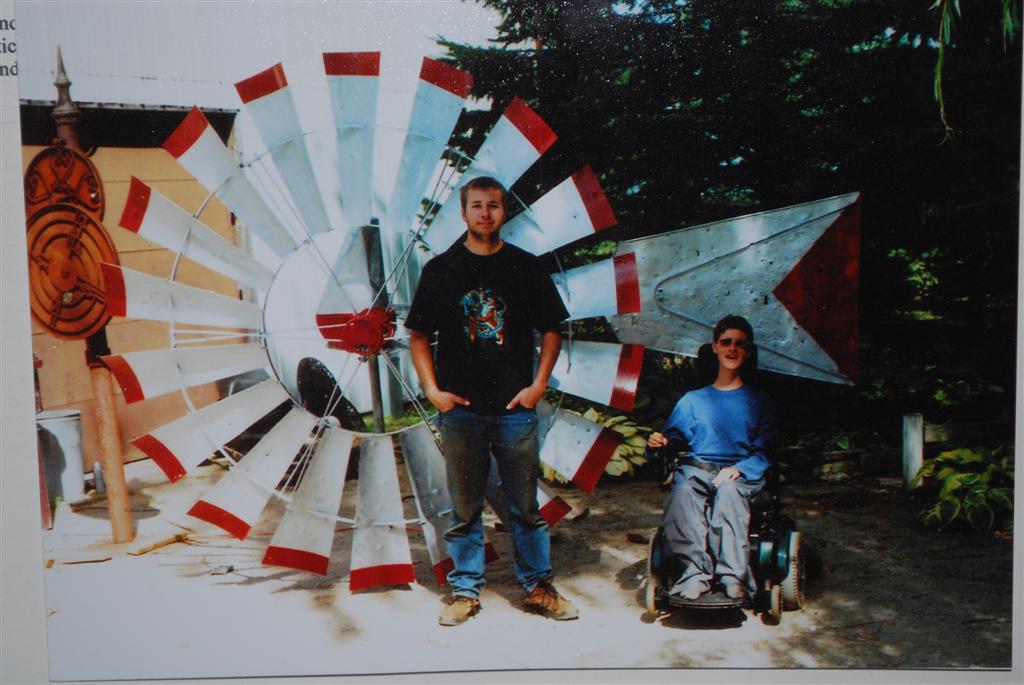
We looked through pictures of other windmills and decided to dress ours up a little bit (though it's probably not traditional) by adding some red paint to the end of the fan blades and to the tail.  When the mill was new, the tail would have borne an 'Aermotor Co'. logo emblazoned across the tail with 'Chicago' stenciled in red letters below it.  We didn't have the stencil, so we just added a  red 'V' to the tail and thought it looked ok.

Another very bittersweet memory to share here; Joel's best friend, Marty, had been diagnosed with Duchenne Muscular Dystrophy as a youngster and was in a wheelchair.   I have never known another person, young or old, with such a cheerful disposition in the face of great adversity.

  Marty was more involved in school activities than my two kids ever were, and was an honor student.  His wheelchair didn't hold him back from typical guy-like outside activities, either.  The two friends would go tearing up and down our side road, Joel on his bike, Marty in his wheelchair, just having a good time.  They also went cross-country through the farm fields here and when they'd get back from the field, Marty's wheelchair would be dragging tall grass and cornstalks underneath.  Marty loved tractors as much as Joel, and used to come over and watch Joel hauling stones off the pile for the Quarry construction. 

Here's a picture of Joel and Marty after we had painted the windmill:

Joel and Marty, juniors in high school,  September 2004.
We decided to raise the windmill head on Labor Day weekend, 2004.  Marty, and his mom, Jill, were here to help, and we couldn't have done it without them.

Below, Joel and Carl are coming down the lane with the windmill head, Carl is steadying the mill so it doesn't spin on the chain suspended on the tractor bucket:

Getting closer.....

Approaching the tower.  Joel on tractor, Carl and David.
Once again, we could not afford to hire a crane to put the windmill head up, so Carl came up with an idea.  He had a system of pulleys, ropes and angle iron rigged up like a temporary crane hoist to raise the head which also, once again, required me on the tractor, pulling. Carl had worked on the idea of how to raise the head for weeks, and was confident it would work.
 
Joel, preparing the tower for the lift.
There was a lot of preliminary work to do before we could get to the actual lifting part.  In the picture above, Joel is standing on the cedar platform, working on the mast head.  The rope seen on the left-hand side of the picture is attached to a bucket which contains nuts and bolts and tools Joel needs.  Marty was in charge of towing the bucket up and down the tower with his wheelchair.  Whenever Joel needed something, Marty would raise and lower the bucket.  You can see how many trips he saved Joel by the tracks in the sand in the picture below:
Marty, in charge of tools.
 Raising the tower back in January could have been a disaster, but there were much higher stakes this time--for Joel would be standing on top of the 40' tower while I was on the tractor, doing the pulling.  One slip with my foot on the clutch of the tractor and a nightmare would play out right before my eyes.  I was very uneasy with this job. Both of the men told me I was being silly, what could happen?

After Joel got everything in place on the stub tower and Carl had everything hooked up to his satisfaction, we were finally ready to give the rope and pulley system a try.  I backed up ever so slowly and the head started to come off the stand.  We all held our breath as it ascended higher and higher, but when the mill was about 20' in the air, the angle irons on top of the tower suddenly bent.  Oh, that was a scary sight!  We were pulling at too much of an angle.

Everyone was safe, yet, so Carl had me drive ahead slowly so he could lower the mill back onto the stand.  Back to the drawing board, Carl made some changes to the hooking arrangement and we tried again.

By now it is getting late in the day, close to sunset again.  There I am, below, holding my breath and praying for all I'm worth that this works and Joel doesn't get hurt. 
Me, staring hard at Joel and keeping steady feet on the clutch and brake.

 In the above picture, you can see the mill is going up, this time we have it hooked correctly.  I am still holding my breath though......

 Almost to the top now.  Joel has the hardest part of the entire job to perform, he has to wrestle this 350 pound mill over onto the mast head on top of the tower while keeping his balance on the tiny platform.  This was the most nerve-wracking part for all of us.
 
Carl was standing in front of me, orchestrating this whole deal---he looks like a musical conductor with Marty by his side in the picture below:
Carl, on ground, conducting; Marty watching, and Joel doing his best not to fall off the tower.

Success yet again!  Joel announces the mill is seated on the stub tower!!  I can finally breathe.

Joel needed a few more tools hauled up the tower again and I volunteered to climb up there with him as I had so much nervous energy to burn off.

Joel and me, hanging around on top of the tower.
As a kid, I used to climb our 40' tall silo to put silo filler pipes up every year, and that was nerve-wracking enough.  I don't have a fear of heights, what I have is a fear of landing after I fall.  I do not know to this day how Joel was able to stand on top of that platform and put the windmill on the tower.  He has nerves of steel!  And I should never, ever have allowed it.  He still climbs up there several times a year, checking the gearbox for oil or just to take pictures.  I have gone up there a few times, but only to the base of the platform.  That is high enough for this old bat.

Joel, going back up to do some final adjustments and unhook the ropes and angle iron hoist.
 Since it is so dark out, it's hard to see in the above picture, but Marty is sitting in the foreground watching Joel ascend the tower.  Jill had taken many of these pictures for us and we truly appreciated her help.  Marty and Jill went home shortly afterward as it was getting quite cool out.  We'd all had a very long day. 

Sadly, the following spring, May 2005, Marty passed away shortly before high school graduation.  The world lost a very, very special young man that day.  He was the most remarkable person I've ever met.  Whenever I look at the windmill, I can still picture Marty the day we put it up, hauling that bucket up and down, always with a smile.


September 2004

May I always remember to be courageous and positive, just like Marty. 

 Marty, 1986-2005

His memory lives on.


Sunday, November 14, 2010

How This All Started, Part 11

So, now we go back to Christmas morning, 2003 and Carl, standing in my mother's machine shed, staring at his gift, an Aermotor Windmill.  He was surprised, to say the least.  "Did you buy this from Arnie?" he asked  incredulously.   Carl was amazed he would part with it.  He just stood there, gazing at the big fan.   If there's one thing Carl loves, it's a challenge, and his favorite challenges are something someone else has given up on. He figures nothing mechanical is unfix-able, all it needs is (and our sons can fill in this blank, for it is their father's favorite saying) "A Little Work".

I succeeded in making Carl a very happy man, he had a little work cut out for him once again.

Carl's attitude is a blessing and a curse; he is an optimistic genius and an incurable hoarder all rolled into one.   I posted some time back on being Married to MacGyver...some of you may remember the late 1980's TV show about the man who could get himself out of any terrible predicament with say, a mere paperclip, a roll of dental floss and a wad of chewing gum?  Poor Mac, he was always having to save the damsel in distress, the pet in peril, or our planet on the verge of destruction with nothing but objects he found lying around.  For all intents and purposes, Carl is my Mac.  The only problem with Carl is, his tools to save the universe take up a whole lot more space than dental floss and tin foil.  And he is forever saving things to fix things...all kinds of things, trust me; things more numerous than you can imagine.  He has one entire building and parts of others dedicated to the Saving of Things.  Sigh.

But back to the windmill...

Our windmill is an Aermotor Model #602, which was built from 1916 to 1933, making it anywhere from seventy-seven to ninety-four years old.  That's a lot of years to stand on a 40' tower, facing the elements.   Despite the mill's advancing age, I thought it looked marvelous.  Compared to the two windmills standing a few miles away from here, pictured below, ours looked very good. 

Carl and one of a pair of abandoned neighborhood windmills, in need of repair.   You can see there are parts of the sails missing and the tower bracing is starting to deteriorate.

This is the other windmill, the picture was taken from my scrapbook.  This one is in better shape, but has plenty of bullet holes.
I find it amazing that old windmills have stood the test of time.  Just think of the force placed on them during high winds!

Not to get too technical, but here's a mini-explanation of how these old mills have survived nearly a century, their design has much to do with their longevity:    Aermotor windmills have a slightly off-center wind wheel counterbalanced by a coiled governor spring.    The wheel automatically turns away from increasing wind because it is off-center which slows its speed.  The increased tension on the spring causes the wheel to return into the wind when the wind decreases.  When the mill is turned off from the ground or when it is completely put out of the wind, a friction brake on the hub tightens, preventing the wheel from free-wheeling.
 
As you can see in the pictures above, most windmills that are still standing have several problems; sometimes the self-regulating brake and furling system wears out and the mill is subjected to high winds, spinning out of control and causing damage.  The tail can bend from the wind force and get caught in the spinning blades, shearing the blades off.   Or there is no oil left in the gearbox, causing the gears to run tight.  The towers are very important too, and if the legs are bent or the bracing fails, the whole apparatus can topple.

However, in my opinion, the biggest problem windmills face is People With Guns.   The inventors of this ingenious device tried to make them fairly idiot-proof, but  probably never envisioned people using their product for target practice.  It's a shame that windmills get picked on so much, but they make irresistible targets for every wayward marksman trying to prove he's a great shot.  The resulting 'plink' of a bullet hitting the mill is their reward.   The poor windmill bears the evidence, another hole.

Talk about survivors: our windmill has been shot at a lot in its lifetime!  There are 106 bullet holes in just the tail alone, not counting the blades or the helmet covering the gearbox.  Most of the holes look to have been made by .22 rifles, but then there are some holes of a much higher caliber rifle ripped in the tin, too.

Hitting the blades or tail of a windmill doesn't affect it's performance too much; it will still keep on turning.  But sometimes the bullets hit a vital organ, the gearbox, which is the heart of the windmill.  This can be the beginning of the end.  Aermotor windmills are self-oiling, their gears rotate in a sealed gearbox full of oil.  The self-oiling mechanism was a luxury to the owners of these mills, who wants to climb up a 40' (or taller) tower to oil a windmill every day?  But once a bullet penetrates the gearbox or the helmet covering the gearbox, the problems can be severe since the helmet protects the gears from water and wind-blown dust.  Oil and water don't mix too well, and the combination does a lousy job of lubricating gears, too.  If the bottom of the gearbox is hit, all the oil may eventually drain out, if the helmet is hit, the gearbox will eventually fill with accumulated water and dirt.   Poor windmills, standing mute while idiots take potshots.

Carl had a few days of vacation coming that year, so he set to work on the windmill the next day, removing the helmet to see what the damages were.  There was one major hole in the helmet which had also hit a tooth on one of the four gears, breaking it.  He was able to repair the gear by doing some creative welding and pounded the jagged hole closed with a hammer and soldered the edges shut.

The tail of our windmill resembles lace in places, due to all the holes, but we decided against making a new one for now.  Despite its damage, it still works fine as do the blades.  There are 18 blades on an 8' mill, and 17 of ours have multiple bullet holes...only one blade managed to escape with a mere dent.

We were lucky that the blades were very straight.  When Arnie took this mill down from it's former home, he did it the right (and the much harder way) by using scaffolding and taking it down piece by piece.  I'm not sure how he removed the actual windmill head itself, which weighs around 350 pounds. I wish I had asked him for a better explanation, but sadly, he passed away about a year after we bought the mill.   He did an awesome job, there were no bent blades.   Some people resort to pulling a tower over to get a windmill head on the ground, but the blades suffer mightily from the crash, becoming bent and crumpled.

When I bought this windmill, the $250 also included most of the tower which had also been disassembled and was stacked up in Arnie's woods.  Not all of the parts were there, one of the four legs was missing, but this was no big deal, really.  We bought some new angle iron from a local steel supplier to complete the tower and replaced all of the cross-bracing too, since the older steel was pitted.

The holidays were now past by a few days, and we had a goofy thought, should we try to put the tower up?   We had quit working on the quarry construction just before Christmas because of  the colder weather and the upcoming holidays.  It was now the 9th of January and we hadn't received any significant snowfall beyond a light dusting, which was very unusual.  The ground was frozen to a depth of maybe three inches but once you chiseled down past the frost, it was easy digging.   The weekend was coming up....why wait?

Siting the windmill was the first decision we had to make, where should we put it?  We wanted to see it from the house but didn't want it in the Quarry itself.  We settled on an area about 75 feet from the pond.  Joel had dug a test hole and found out there was water under the windmill's site too, so the decision was made.  At some point in the future, we hope to make the windmill actually pump water for the waterfall, but that's another project for another day.

 We had done some hasty research on the internet searching for 'the best way to raise a windmill tower' and found out the best way would be with a crane capable of reaching 40' in the air complete with a nice bucket on the boom where a person could stand and work.  That would be the best way, and of course, a quite costly way, and ever-mindful of the Frayed Shoestring Budget, out of the question for us.  Our next option was to build scaffolding to a height of 40'.....but if we had that sort of time and money, we may as well hire a crane.  So the next option was to dig holes for the legs, attach one end of a cable to the top of the tower and the other end to a tractor and pull.  That idea sounded about right to us, it was completely dysfunctional, risky, dangerous and Cheap.  Ok, we have a plan.


January 8, 2004 was spent getting ready to raise the tower.  The first thing we had to do was dig four holes 5' deep for the windmill legs.  After several hours of digging, the holes were ready.  The next morning,  we assembled the tower.  January 9 was ridiculously warm for Wisconsin; we hit 45 degrees which was nice, but by midafternoon, a light rain started falling.  In the picture below, David is sorting through the bracing and getting ready to put the bolts in the holes to form the cross braces:
Dave sorting bolts for braces, January 9, 2004.
Carl working on the layout of the tower parts.

  The loose dirt in the foreground is from the hand-dug holes for the tower legs. 
January 9, 2004
In the above tower assembly picture, David, Carl's father, Don, Carl and Joel are all working on tightening the braces.  Daylight is dwindling and the mist is starting to turn to rain.


The view from the top of the tower looking back.  Left to right: David, Carl, Don and Joel.

It was getting to be very late afternoon when these pictures were taken, so there was little light for photography. It began to rain harder, so we had to quit.  The weather forecast for the next day was for a cold snap coming in with falling temperatures as the day progressed.   We knew we had to hurry and get the windmill in place before the temperatures dropped too severely because we needed to pour cement into the holes after the tower was in place.  We went to bed and hoped for good luck the next day.

The next day, Jan. 10, 2004, dawned sunny and colder with a rather brisk breeze.   We brought both of the tractors out to the windmill site and hooked up the very heavy 100 foot long 1/2" thick cable to the head of the windmill.  Carl put boards in the two front holes so as we raised the tower all in one piece, the legs would catch on the two boards and simply fall into the holes.  Then as the tower continued to be pulled upright, the other two legs should just as neatly plunk into the next two holes and we'd have an upright tower.  Sound like a plan?

In the picture below, Joel has the tower hoisted as high in the air as the Super H can lift.  This is also one of only a handful of pictures we have of the late and great rock hauler, the Mighty Buick Century and our little trailer. 
Tower partially raised, waiting for the final lift.  January 10, 2004

Carl tied two 100' long guide ropes to either side of the top so the tower could be guided in one direction or the other as the tower was being pulled up.  Luckily, our two young neighborhood friends, Dale and Eric, were available to come over and help with this crazy endeavor.  Carl and Joel took the rope tied to the west side of the tower, Eric and Dale took the rope on the east side and I was on the south side with the pulling tractor.

We all discussed what everyone's role would be and what hand signals we would use and then everyone manned their battle stations.  My biggest problem was the fact that I could not see anything to do with the tower or the men from where the tractor was sitting over 100' away.  I was right next to the quarry pond with only a narrow space between the quarry and the barn to drive on, so I had to make sure I didn't run into anything as I drove slowly ahead.  Behind me, the spruce trees blocked my view completely.   I had to rely on David as the go-between to tell me to start or stop. 

Tower going up, frantic Carl and Joel on left side pulling while Dale and Eric try to guide it straight on their side.

Carl yelled, "Ok, let's give it a try!" and I fired up the 574 and eased the clutch out ever so slightly.  I kept monitoring my forward progress with the barn and quarry while trying not to look away from Dave for anything more than a few seconds as he watched the process from his angle. Dave was also in charge of photographing the event, too, so he had his hands full.

What I didn't know was Carl was yelling for me to stop pulling, but Dave couldn't hear him from where he was standing.  The tower slid toward the holes and Carl decided he wanted me to stop pulling so they could try to wiggle the tower in by hand.  David misunderstood and kept motioning me to go forward, so I didn't have a clue.  Meanwhile, behind the trees, the four guys were furiously pulling on their guide ropes, fighting with the unruly tower for all they were worth. Suddenly, over the trees, I saw the tower's mast rising.  Dave started gesturing wildly and I couldn't tell if I was supposed to stop or go, so I stopped.  By this time, the tower was nearly straight up and down anyway.  (I guess we should have worked on our hand signals and choreography a BIT more.) 
SUCCESS!!!
Despite the fact I had been pulling when I should have stopped, the guys managed to guide the tower into position.  All four legs had dropped neatly into their assigned holes and nothing and no one was bent or harmed in any way.  What a relief!  It was around 3 PM.

After thanking Dale and Eric, they headed for home.  We still had to pour cement in the holes to stabilize the tower and it was growing dark and much colder, so time was of the essence.  While Carl and Joel brought out the bags of dry cement from the garage with the wheelbarrow, I hauled five gallon pails of hot water out of the house one after another for the cement mixing.  We worked until long after dark, with Carl continuing mixing cement while Joel helped me haul water.  We were so glad to be done, finally, around 7PM.  We had some straw bales available to pile up and over the holes so the cement would cure without freezing.  The temperatures dropped substantially that night, well below freezing and it started to snow.  Winter had finally arrived.  We were truly done working outside now until spring.


Joel climbing down from the newly installed  tower.   January 2004


Next chapter:  The insane way to install a windmill head.

Thursday, November 11, 2010

How This All Started, Part 10

I thought I should show at least one photo of flowers taken during the time period we built the Quarry.  This is the River Bed in August of 2003, looking out toward the quarry construction and the barn.  My wash lines have since been moved behind the garage so they don't clutter up the lawn.

I took this picture from the house, out of the window with THE best view of the gardens out back...the bathroom!  Yes, that's right, the best place to see the garden is from our potty.  How sad is that?  Once again, our lack of planning in action.  Our Grand Plan for the distant future is to remodel our tiny house a bit so we can enjoy the garden from the kitchen and dining room.  Someday.

 So, here we are, back in November of 2003, behind the waterfall rocks, looking back toward the house.  Joel and I were busily hauling the sand back from the pile up by the woods so we can build a hill.  Carl was constantly shoveling between loads, tossing the sand where he wanted it.  While I was at the construction site unloading, Joel would move the sand pile up by the woods around a bit so he was ready for my return.   The turn-around time from the trailer being loaded to my coming back for the next load was around ten minutes, unless Carl and I had problems dumping the trailer. When we had enough sand piled up by the quarry, Joel would follow me home with the Super H and push the sand around at the construction site for us and then we'd get back to placing rocks for awhile.  The routine was load sand, haul sand, dump sand, get another load of sand and place rocks.  Shovel, repeat.

I should mention the trailer here, too...these pictures were taken during the Thing Garden construction this year:
Carl's dad built this old dumping trailer and used it to haul dirt for his first home construction project in the early 1950's, before Carl was born.  It is the box, axle and tires off of an old pick up truck from the 1940's...I'm not sure what make of truck it was, but to say they built them better back in the day is an understatement.   The trailer tongue weighs a lot, wimpy me always has to prop it up on a block of wood or a rock after I unhook it from the tractor or I can't lift it to put it on the tractor's hitch.  We all marvel that the thing has lasted as long as it has, we have put it through so much abuse.

The waterfall and start of the hill from the other side.
In the above picture, you can see the individual loads of sand as I'd dumped them prior to Joel coming with the Super H to pile them up a bit.  As soon we built the sand high enough, we could start placing rocks again.
This process went on for weeks.  We were always anxiously watching the weather for signs of the Big Freeze because once the  rocks were frozen down, we'd have to quit.  Finally, in the first week of December, the weather changed and we were done for the year.

Or so we thought.

I hope you don't mind this detour from the garden construction, but here we go:

It was now near Christmas and I had a surprise up my sleeve for Carl.  Well, not up my sleeve, it was WAY too big a surprise to store it there.  I have never had good luck surprising Carl with Christmas presents.  He doesn't get excited by much unless it's tools or something 'cool' (no shirts or socks, please). 


When Carl and I had gone to Arnie's scrapyard in the spring of 2003 and found the Manley Wrecking Crane instead, another thing we'd seen in the man's vast collection of All Things Useful was a windmill.

An Aermotor Windmill.  (I wish I could cue heavenly music to play...)

Here we go down memory lane again...our farm used to have a windmill, but it was way before I was born.  There are two windmills about three miles from here that stand on either side of a road much like ours.  Whenever Carl and I would drive by those old windmills, it was so nostalgic, we used to think how nice it would be to own one.  (The people who do own those two mills aren't selling, by the way.) 

For nearly a century, a windmill was a common sight on farms, they were the workhorses that supplied water to cattle.  Aermotors were considered to be the Cadillac of Windmills, at least around here.  With the advent of electricity, windmills fell out of favor and were replaced with electric pumps.    Many windmills literally fell over the years from lack of maintenance and windstorms, but I think the biggest problem was the demise of the family farm.

When I was a kid, we were surrounded by family farms, there were dozens of them.  You knew everyone and they knew you.  Now that's all changed.  The trend is now to the Mega Farm with thousands and thousands of cows...one operation near here has over 5000 cows on one farm;  I find it hard to wrap my mind around that many cattle all in one place.   When times got tough in the 1980's, many farmers simply quit and sold their land off either to the huge farm operations or for housing developments or to another concern who is offering top dollar.  It was just too hard to keep trying to make a living. I understand that, but I sure miss the family farm.  I'm the only one left on this stretch of road who still has all the original farm land intact.   In the past, people have asked Mom and I to sell them parcels to build a house and though we could use the money, we've refused.  We rent it out to one lone neighbor who is still farming.  The old farmstead means too much,  it is too dear. I want to hang on as long as I can.

They don't make land anymore.

I guess that's why the nostalgia bug bit me so hard when we had seen the Aermotor sitting on the ground in front of a pile of other scrap metal at Arnie's house.  I thought about it constantly, but didn't know if Arnie would want to part with it.  I enlisted the help of my father-in-law to help me with this mission as he knew Arnie.  One fine day in December while Carl was at  work and the boys were in school, my father-in-law and I headed over to see him.   Arnie said he had purchased and taken the windmill down from an abandoned farm over a decade before, and he had intended to put it back up to run an aerating pump for his pond, but he never got around to it.  His health wasn't what it had been and putting up a windmill is not easy work, so he decided to sell it to us for $250.  I was so excited, maybe, for once, I could surprise Carl.

My father-in-law and I loaded up the windmill head on the back of his truck and brought it home.   But it was three weeks til Christmas and where could I hide something that big from Carl?  I decided to put it in Mom's old machine shed where we store our greenhouse and shelving in the off-season.    The boys knew all about it too, but managed to keep it a secret. 

I purchased the biggest red bow I could find, tied it to the center hub and waited for the 25th.  On Christmas morning, when everyone was done opening their presents, I told Carl that Mom needed some help with some plumbing at her house.  "Can it wait until tomorrow?" he asked.

"No," I said, "She says the faucet is leaking badly, so we'd better go before dinner and get it fixed.  Come on, the boys and I will help you, it won't take long.  By the time we're done, it will be time to eat."

Carl groaned, he didn't feel like fixing a leaky faucet on Christmas Day, but being the dear heart he is, he obliged.  When we got up to Mom's, I had to think of some reason to get him to go to the machine shed.

"As long as we're here, could you move the shelving unit in the shed closer to the door?  As soon as Christmas is over, I really should get at starting the geranium seeds for spring."

"You want me to get the shelves out now?"

"Oh, could you?  And Joel and Dave are here, too, it won't take that long."  Once again, he obliged, but grumbled a bit.

At this point, I think he may have been suspicious, though he hid it well. However, I will never forget the look on his face when he shoved the old shed door open and came face to face with an 8' tall Aermotor Windmill head sporting a big red bow.  After 24 years of marriage, I had finally surprised him!

With more work.


Up next: how to put up a windmill.

Wednesday, November 10, 2010

How This All Started, Part 9

Here we go with Part 9 of the saga.  As the fall of 2003 lingered on, we continued working on the quarry.  In the picture above, Carl and Joel are getting ready to place the top rock on the little grotto-like sitting area. 
Joel is cranking the Manley Crane and Carl is guiding the rock into position
I remember asking Carl and Joel to pretend to be holding the ceiling up--yes, it was a corny shot, but they obliged me anyway by posing.

Once we were done with the little grotto-thing, we moved on to the east side of the quarry.  There we added the third and final staircase and finished up the terracing.  I had planted Wave petunias that year and they did surprisingly well considering the soil is almost pure sand.
It was at this point we realized the water level wasn't going to get any higher, so we had to add some more rocks to line the pond.  We wanted to have a row of stone to walk on and be next to the water.  The lowest rocks seen in this picture were brought in after the terrace rocks; it was a hassle beyond belief to get those stones in place!  We had to back down over the terrace rocks with the wrecker.   The water levels are a constant variable in the pond, and will be forever.  Some years, the ground water table is high, like this year, 2010; but in drought years, we are down to a mere puddle.  Yes, the perils of being a do it yourselfer. 
September  2003, putting the 'walking rocks' in place, backing the tractor and wrecker down in the hole was nerve-wracking. 

 We couldn't afford to line the pond, though we did talk to a pond specialist once after the quarry was in place for a few years.  He said it would be possible to put a liner in despite the fact the ground water rises and falls so much.  Oh, there was something about baffles and specialized pumps and equipment mentioned as he outlined our options.   I started to glaze over but jolted to attention when my checkbook burst into flames when I heard the estimate.  He was a very helpful person and I highly recommend talking to a professional to anyone considering a pond.  Unfortunately, we operate on the Flimsy Shoestring Budget and our shoestrings were starting to fray.  I doused the flaming checkbook and we thanked the man and left.

We have put rocks much lower in the water in recent years, trying to make the 'pond' more attractive as the water levels drop, but well, we weren't very successful.  Over the years, many a visitor's favorite comment has been:  "Your pond would look much nicer with more water in it."

Yes, it would, but without a liner, there's no way to keep it at a constant level.  We just live with whatever Mother Nature provides.  I'm certainly not about to stick a hose in there and run our well dry trying to keep the pond pretty.

 In this picture, taken in 2005, we have very low water conditions.  We were also using dye in the pond at that time, with mixed results.  This was taken before the north quarry hill addition..
 
 In this August 2010 picture, you can see the water is actually covering the rocks we usually walk on.  (I see we also have an algae problem too....)  The trees were removed and the north hill is in place, which is why everything looks so much different.  But the main point of these two pictures is to show what rainfall does to this so-called pond of ours.  If we get rain, we have a pond, if we don't, we have a puddle.  Feast or famine.


We had to pass on having a gorgeous pond.   Carl said the water level in real quarries fluctuates a great deal with the ground water levels, too.  We aim for reality here at Quarry Garden...that's our motto.  Cheap Reality.  (And yes, sometimes reality bites....)  Hey, it's all about the rocks anyway, at least for us.
Ok, back to east wall construction:

  
Finally, in late October of 2003, one year after the hole was dug, we had the lower quarry itself done.    In the picture above, David and Carl are standing on the east staircase, the third and final stairs Carl put in for access in and out of the quarry.

By now, it was approaching mid- November 2003.   We took a look at the waterfall again.  We weren't satisfied with the way it looked (and still aren't, sigh) and decided we needed something behind the pile of rocks to make it look more natural.   Not that a pile of rocks in a flat, former alfalfa field ever looks really natural, but that was our goal, ok?

We had to begin to haul the 30 dump truck loads of dirt from the quarry excavation back to the quarry site one yard at a time from the pile up by the woods.  We needed the sand to build the area up into a hill so we could keep putting rocks in place behind the waterfall rocks.  This is the way it worked: Joel and the Super H would head up to the sand pile, a quarter mile away in the Back Eight, and I would follow with the 574 and the dump trailer.  He would load my trailer and I'd drive back down the lane to where we were working.  Carl would tell me where to dump it and I'd head back up to the woods for the next load.

Talk about being happy to have a tractor with a loader on it!  Consider this: the average dump truck holds around 30 yards of soil.  We had 30 dump truck loads hauled to the woods, and our little trailer only holds a yard.  So, over the next six years, we hauled home 900 yards of soil one load at a time for the quarry garden additions.  900 trips one way.  But at least we didn't have to shovel them. 

Joel, Super H and the ever present crowbars, rocks and sand adding dirt for the next part of the project, the Quarry Hill.  November 2003.
 I've said it before, but I'll say it again, I LOVE TRACTORS!